
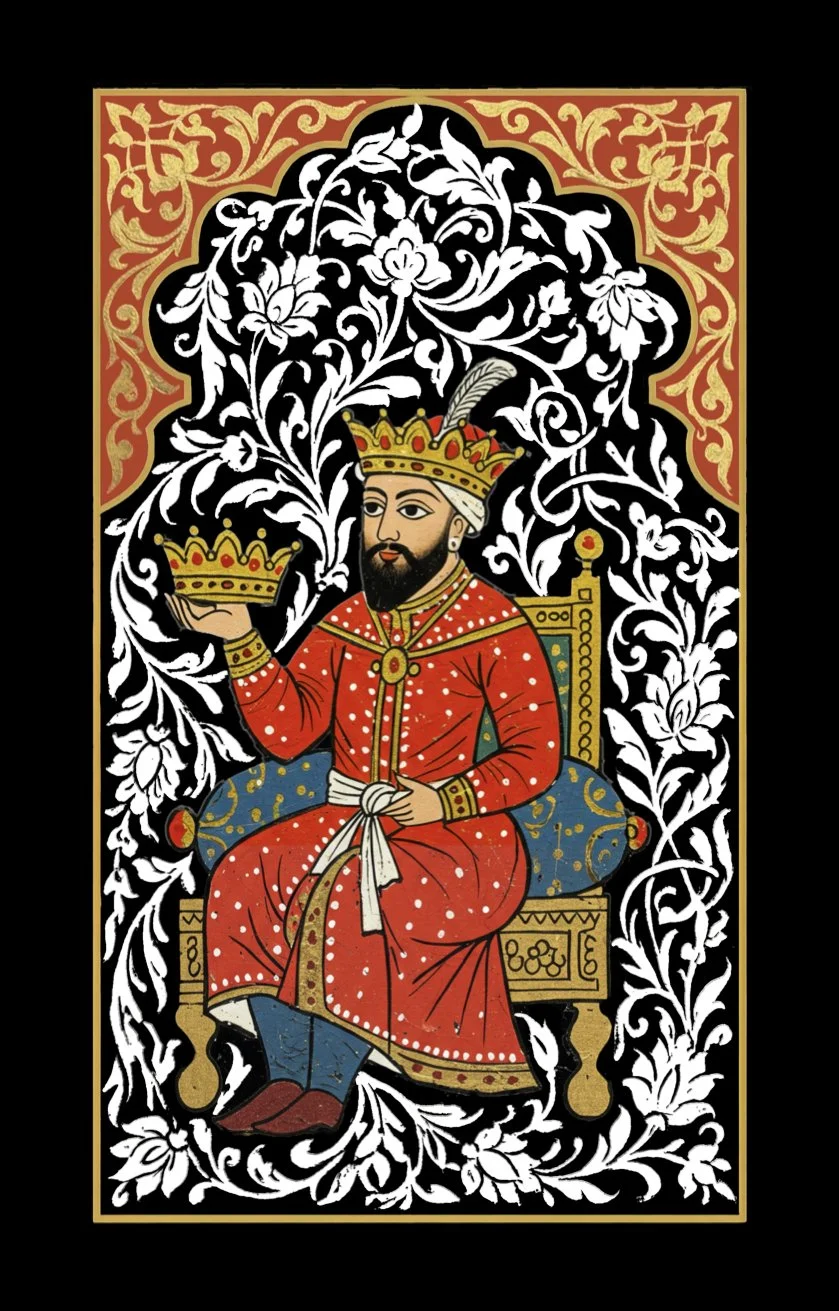
Reconstructing the Lost Game of Ganjafeh
When our team first came across a reference to a card game called Ganjafeh, played by courtiers in the 16th-century Safavid court, we wondered what we could do to help research, revive, and maybe even repopularize it.
The task got challenging fast, because “Ganjafeh” refers to different games from various regions and time periods. What we’ve put together here focuses exclusively on the Ganjafeh of the 16th-century Iranian Safavid court.
This deck is our best reconstruction of that lost pastime. We have drawn from poetry, historical accounts, material artifacts, and modern comparisons to restore the spirit and likely rules of a game played over five centuries ago. We have also explored the deck's potential for divination based on the work of the Safavid poet Ahli Shirazi by translating and interpreting his verses for each card.
We hope that when you interact with this deck, you feel connected to a long and storied tradition.
Ganjafeh Rules
The Deck
Players: 2, 3, or 4
Deck: 96 cards. There are 8 suits with 12 cards per suit.
Goal: Ganjafeh is a trick-taking game where each person plays a card, and the highest-ranking card wins the round. The winner of that round (either an individual in a 2- or 3-person game or a duo in a 4-person game) collects all of the cards played in that round. The final winner is the person or team with the most cards once all 96 cards have been played.
In Ganjafeh, 4 of the 8 suits are Bishbar, where higher-numbered cards beat lower-numbered ones. The other 4 suits are Kambar, where lower-numbered cards beat higher-numbered ones:
Bishbar (in which 10 beats 1):
Ghulam غلام - Servant
Taj تاج - Crown
Shamsheer شمشير - Sword
Safed تنکه / سفید - Silver Coin
Kambar (in which 1 beats 10):
Surkh اشرفی / سرخ - Gold Coin
Barat برات - Decree / Draft
Qimash قماش - Textiles / Goods
Chang چنگ - Harp
Each suit contains a Shah (King), the most powerful card in that suit, and a Vizier, the second most powerful card. The Shahs and Viziers are always the most powerful in both Bishbar and Kambar suits. This structure mirrors the hierarchical nature of Safavid governance.
Reading the cards: part of the challenge will be deciphering the cards. To stay true to the look of cards at that time, we did not include the suit and number markers in the top corner, like you would find on modern cards. All Shahs are pictured sitting on a throne with a crown and all Viziers are standing. Because there is no clear symbol for the Ghulam / Servants suit, we have used a female Shah and a eunuch for the Vizier, shown with no beard.
The Set Up (4 people, 2v2)
Seating: Players traditionally sit in a circle around a cloth. When playing with 4 people, the partners sit opposite one another so that, in the round, it goes Team A, Team B, Team A, Team B.
Choose the Hākem (Ruler): Before the game begins, determine who will be the first Hākem. The Hākem decides the Hokm (the ruling suit) for the entirety of the game and gets to play the first card. To find the Hākem, one person deals cards face up to everyone, one by one. The first player to receive a Shah card becomes the Hākem. The person to the right of the Hākem becomes the Dealer and reintegrates those dealt cards into the deck.
Determining the Hokm (Ruling Suit): This is a critical step. The Dealer deals the Hākem 8 cards first (face down). The Hākem looks at these cards and announces which suit they will designate as the Hokm based on their hand. If, for example, they have a Shah and a 10 of Shamsheer (Sword), the Hākem would want to choose Shamsheer as the Hokm.
Dealing the Rest of the Cards: Once the Hokm suit is announced, the Dealer distributes the remaining cards to all players evenly so that each person (including the Hākem) has the same number of cards. The players can look at all the cards in their hands.
The First Trick: A trick is a round in which each player plays one card.
In the first trick of the game, the Hākem plays the first card.
The player to their right goesnext and so on (in a counter-clockwise direction).
Players must follow suit if possible.
If you cannot follow suit, you may play a Hokm card to win the trick or discard a card from another suit.
Whoever won the first trick (by playing the most powerful card) starts the next trick.
The Hokm stays the same throughout the game until all cards have been played.
Example 1:
The Setup: The Hākem (Ruler) has chosen Shamsheer (Sword) as the Hokm.
The Lead: A player from Team A won the last trick, so they start the next trick. They play the Vizier of Qimash (Textiles).
Following Suit: All other players must play a Qimash card if they have one.
The Result: Team A will win this trick, unless Team B can do one of the following:
Play the Shah of Qimash, which is the only card in that suit higher than the Vizier.
Play any card from the Shamsheersuit (the Hokm). Note: A player can only do this if they have no Qimash cards left in their hand.
Example 2:
The Setup: The Hokm is Taj (Crowns).
The Lead: The starting player plays the 1 of Surkh (Gold Coins). Because Surkh is a Kambar suit, the 1 is the most powerful number card.
Following Suit: All other players must play a Surkh card if they have one.
The Result: The 1 of Surkh will win the trick, unless the opposing team can do one of the following:
Play the Vizier or Shah of Surkh (the only court cards that outrank the 1).
Play any card from the Tajsuit (the Hokm), assuming they have no Surkh cards left to play.
No table talk is allowed between partners!
Winning
When all cards have been played, the player or team with the most cards wins. The winner(s) become the Hākem and a new game can start.
Ganjafeh Rules for unusual player combinations
3 player (1v1v1)
The core gameplay loop remains untouched, but you are only trying to outplay two opponents instead of relying on a partner. Winner is the person with the most tricks won
The 6 player Rules & Setup (3v3)
Everything remains the same like the standards game. Only each player gets 16 cards. Winner is the team with the most tricks won.